Global English
Organisation
1. Globalisation
2. Englishised
languages
3. The eminence of English
4. The pragmatic and mathetic functions
5. Hegemony, homogenisation and
marginalisation
6. The empire writes back
1.
Globalisation
What is globalisation? You can explore this Open
University website which discusses technical and cultural aspects of
globalisation.
Many think of it in economic terms (the integration
of economic systems, the removal of trade barriers, the
reduction of protectionism) and it is undeniably capitalist in orientation, but
could potentially involve social, cultural and political aspects. Globalisation
is not without its critics, though, and many working in aid organisations,
environmentalists and many left-leaning thinkers see the drive towards a
globalised economic system powered by corporations and banking institutions
(and, in particular, Anglo-American ones) that are totally motivated by the
profit motive and couldn’t care less for the small fish in the sea.
Globalisation is also sometimes seen as being the same thing as Americanisation
– and notable voices include Mahathir. Many are concerned about the imposition
of a uniform culture – a McDonaldisation in fact.
We can think of globalisation beginning with the first great
expansion of European capitalism that took place in the 16th century, following
the first circumnavigation of the earth in 1519 to 1521, and, as they say, we
have never really looked back since.
Key players in favour of globalisation include international organisations (The World Trade Organisation (WTO), The International Monetary Fund (IMF), The World Bank, The United Nations (UN) and The Organisation for Economic Co-operation and Development (OECD)) as well as businesses and governments who see this benefiting their company or country.
2. Englishised languages
Evidence of the influence of English can be seen in the way
other languages are (a) being ‘Englishised’, some perhaps at a fairly superficial level
but others at a more profound one, (b)
losing some domains to English (eg education, law,
business), or even (c) replaced by
English (eg Welsh, Gaelic, Native Americans,
Australian Aborigines switching to English). On the superficial level is
perhaps the use of decorative English particularly in
Japan
· Foppery Let’s go out looking smartened up (on a shopping bag)
· Let’s sport violent all day long (on a T-shirt)
· My tasty time (the slogan of a telephone company)
· I always feel there is something wonderful at the top of the upward slope and I will surely meet a stunning he standing there down up to the slope (on stationery)
· Champs
· Boys Love Big Sun Shine
· Green Grass
· Little Girls Scream
· They are named Champs
Korea
· My boastful hot apple tea (in a notebook)
Indonesia
· The breeze touching their cheeks
· They just remember remote from place
· When they sees quietly the level
(McArthur 2000: 27)
Loan-words from English are also evident in many languages. The following can be found in Japanese, though written in the Japanese syllabary (the katakana characters).
· aisukurimu (ice cream)
· erekutoronikusu (electronics)
· kurisumasu (Christmas)
· remonedo (lemonade)
· takushi (taxi)
· apato (apartment building)
· sekusu pato (sex expert)
· terebi (television)
· bakkumira (back mirror = rear-view mirror)
· moningusabisu (morning service = set breakfast)
· poke beru (pocket bell = pager)
· shiruba hauzingu (silver housing = accommodation for the elderly)
(McArthur 2000: 27–28)
Or take the example of Malay (Bahasa
· cek (cheque)
· gostan (go astern)
· hospital (hospital) – previously, rumah sakit (rumah = house; sakit = illness)
· inci (inch)
· lesen (licence)
· mekap (make-up)
· poskod (postcode)
· sepiar (sphere) – although the recommended version today is sfera
· teksi (taxi) – previously, kereta sewa (‘hired vehicle’)
Some are truncated or cliticised:
· gabnor (governor)
· orkes (orchestra)
· prinsip (principle)
There are also various compounds:
· lif hidraulik (hydraulic lift)
· status sosial (social status)
· krisis perlembagaan (constitutional crisis)
· baju weskot (wasitcoat)
Less obvious might be cases of loan translations (calques)
· tirai besi (iron curtain) – note the reversed order, as is normal in Malay (tirai = curtain; besi = iron); also perang dingin (cold war)
·
Perdana Menteri (Prime Minister) – note that the English order
is maintained here (Perdana = Prime; Menteri = Minister), so that English appears to
influence Malay grammar as well; also Timbalan
Pengarah (Deputy Director) and Naib Pengetua
(Deputy Head). Compare the order of other titles which follow the more
conventional Malay word order for noun phrases like Menteri
Besar (Chief Minister), Profesor
Madya (Associate Professor) and pegawai kanan
(senior officer; kanan
= ‘right’, literally). We can also recall how the French influence in
Syntactic calques (the borrowing of English structures, including metaphors) include the following:
· sebagai akibat dari (as a result of)
· memainkan peranan dalam (to play a role in)
· tidak dapat dinafikan bahawa (it cannot be denied that)
· mendapat lampu hijau (to get the geen light)
· memberi gambaran yang salah (to give the wrong picture)
English can also be prominent in the linguistic landscape (or ‘cityscape’) in places where English is a foreign language.
3.
The eminence of English
The eminence of English as a global language can be seen in terms of four criteria.
(a) Numbers
The world population is about 6,000 million. There are various estimates of the number of languages in the world (the difficulties involve the problem of distinguishing between languages and dialects, and deciding if different names actually refer to the same language. The thirteenth edition of Ethnologue lists 6,703 languages.
About 304 languages have more than 1 million users; of
these, about 82 of these languages have 1 to 10 million users and
The vast majority of languages have less than 1 million users.
(See https://www.ethnologue.com/statistics/size)
(b) Spread and distribution
There are over 1,000 million speakers of Chinese so it takes
top position in terms of numbers. However, it includes several
mutually-unintelligible dialects (Mandarin, Hokkien,
Cantonese, Teochew, etc.). More importantly, it is confined by ethnicity and
area
English, by contrast, is used by some 300 million people in
twelve inner circle countries:
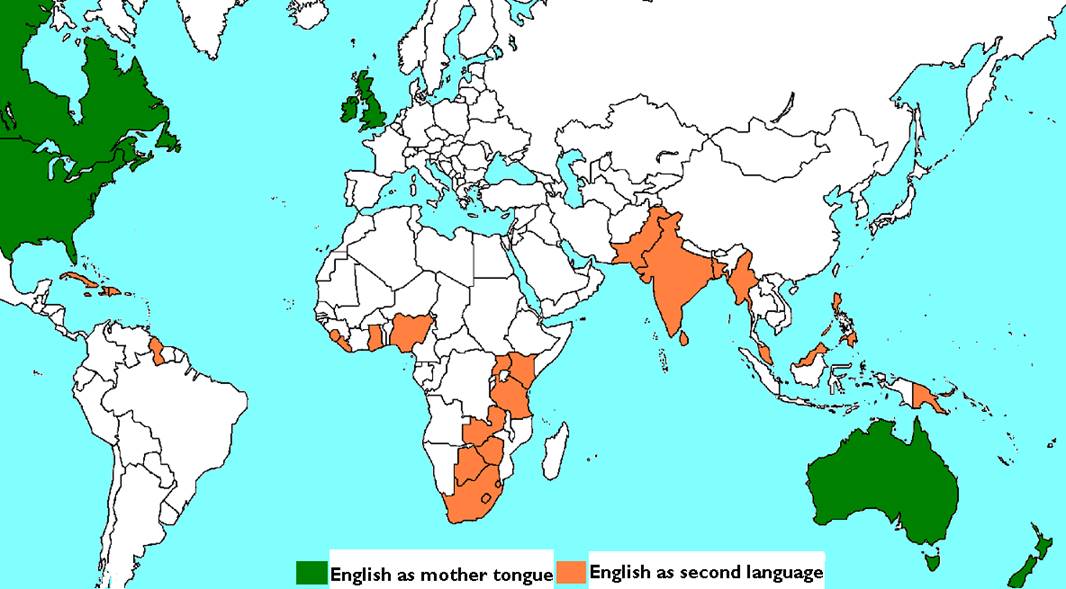
English is also an additional language for 450 million in
bi/multilingual contexts – the outer circle countries:
The estimated number of people who are learning English as a foreign language in countries where English has no official status is 1,000 million (the ‘expanding circle’ countries). Important to note is the keenness of the Chinese to learn English.
Finally, English is an international language world-wide and
is used in international institutions (The British Council, FAO, ILO, IMF,
UNESCO, USIS, etc.) guarantee its maintenance and spread.
the
ideology of linguistic pluralism characterising UN and EU is at best symbolic,
as this ideology has practically maintained the hegemony of English and, to
some extent, the other languages of power. This suggests that ASEAN may not
have much to learn from EU or UN for an alternative to its English-only policy.
(Lee et al 2021)
(c) Vehicular load
English carries the heaviest global load of functions among
all the languages of the world.
Commerce, trade, banking
Japanese businessmen use it when negotiating deals with
Kuwaitis, Swedes use it when speaking to Mexicans, Hong Kong bankers use it in
The multinational ARAMCO taught English to 12,000 employees
in the
Even in non-inner circle countries, ‘English is a top
requirement of those seeking good jobs – and is often the language in which
good jobs are conducted’ (Quirk et al.)
Erling & Walton (2007) studied
practices in multinationals in
In each of [the companies] English is no longer merely a useful additional skill: it has become a necessary basic qualification. Whereas in the past only top management had a need for English, now young middle management uses the language regularly and is likely to have even stronger skills in the language. (Erling & Walton 2007: 39)
It is of course not clear if practices in
 Diplomacy
Before the First World War, the official language of
diplomacy was French; by end of Second World War, English had become the equal
of French.
The United Nations has six official languages – Arabic,
Chinese, English, French, Russian and Spanish: but English has a pre-eminent
position.
Military domination
The Iraq Wars (1990, 2003), the Bosnian war (1991), the war in
East Timor and the aftermath of the terrorist attack in America (11 September
2001, ‘The War against Terror’) was conducted and reported predominantly in
English. (What is interesting in the 2003 Iraq War though is that on top of the
English-dominated western media – CNN and BBC
– we are now also seeing stations based on the Middle East such as the Arab
satellite television stations al-Jazeera (‘The
Peninsula’) and ART (Arab Radio TV Network).)
Education
With nationalism and self-determination, growing awareness
of the need for universal literacy, etc. in many former colonial countries. The
pattern is for English to be employed as the language of higher education,
whereas at the primary-school level, indigenous languages
In many non-inner circle countries, university level education, particularly in the technological field, is in the English medium.
Many countries are introducing the English language into the curriculum earlier. Thailand, which has had no colonial history, is introducing the English language at the beginning of primary school.
German and Italian have been
replaced by English as the primary language in physics journals. In the domain
of science and research, the languages of publication until the end of World
War II were German, French, and English. Today English alone clearly prevails
as the dominant code within this domain. Data from as early as 1980 illustrates
the dominant presence of English in abstract listings for the natural sciences
(Hilgendorf 2007: 138). Journal titles in Germany have also been changed from German to
English, sometimes through a Latin title. For example, Radiologische Rundschau became Radiologia Clinica before finally becoming Diagnostic
Imaging.
|
A German title |
B German title |
C Latin title |
D English title |
E English title |
|
Only German contributions |
Contributions in several languages |
Only English contributions |
||
Steps in the shift from German to English as the language
of publication for journals (Ammon
1991: 263)
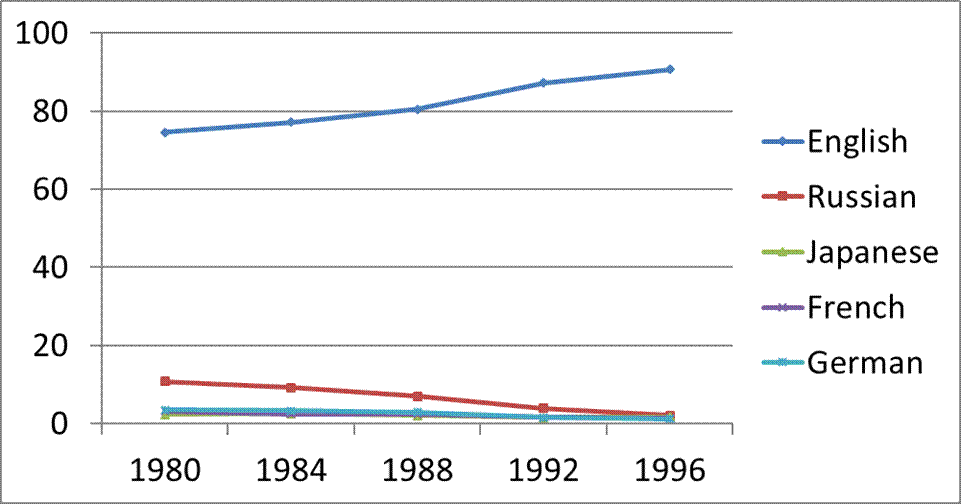
In 1880, one study found that in international publications, the distribution of languages used were:
· English: 35.8%
· French: 27.2%
· German: 23.6%
· Russian: 1.5%
· Japanese: 0%
(Based on Hamel 2007: 56)
Although English garnered the highest percentage of articles, French and German were significant languages too. Since then, however, the position of English has strengthened considerably as seen in the more recent distribution in the table below (from Hamel 2007: 57).
Publications, Media, Communications
Of the scientific papers in the world, 80% are estimated to be first published in English. Book production dominated by English. There are English newspapers 22 Asian and 25 African countries. 80% of Newsweek International’s 325,000 circulation is in the Atlantic/Pacific region. Radio and television is also dominated by English – 60% of broadcasts in English (BBC, ITN, CNN, cable networks, multi- media corridors, the Internet). It is estimated that 70% of the world’s post is addressed in English. English is the language of the Internet. Non-English websites often advertise the availability of an English-language version, but not vice versa.
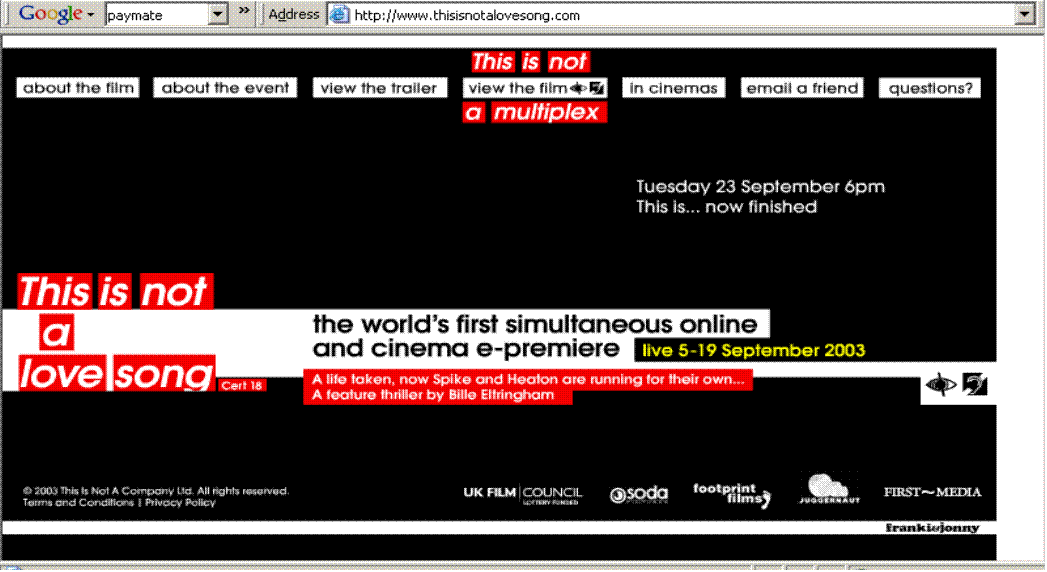
Mark Boardman suggests that the English noun phrase is especially suited to the web:
 This
ability to cram multiple pre-modifiers in before the head noun is symptomatic
of English. English allows, subject to human memory, an almost limitless string
of adjectival or nominal pre-modifiers before the head of a noun
phrase. If the same phrase were translated in French, it would almost certainly
have to include several sub-clauses as post-modifiers. If were
translated into German, there would very likely be several neologisms
created by the compounding of free
morphemes. Does this mean English is a more natural web language than some
others, because of its tendency towards compressed noun phrases of the type
illustrated above [‘the world’s first simultaneous online and cinema e-première’
in the website http://www.thisisnotalovesong.com]?
Where instantaneous decoding of lexical meaning and semantic relations is
important, in the instant where the casual surfer decides whether to stay at
that page or hit the Back button, perhaps the English noun phrase structure
offers the kind of condensed linguistic code that web designers need. (Mark
Boardman (2005), The Language of Websites, p. 61)
This
ability to cram multiple pre-modifiers in before the head noun is symptomatic
of English. English allows, subject to human memory, an almost limitless string
of adjectival or nominal pre-modifiers before the head of a noun
phrase. If the same phrase were translated in French, it would almost certainly
have to include several sub-clauses as post-modifiers. If were
translated into German, there would very likely be several neologisms
created by the compounding of free
morphemes. Does this mean English is a more natural web language than some
others, because of its tendency towards compressed noun phrases of the type
illustrated above [‘the world’s first simultaneous online and cinema e-première’
in the website http://www.thisisnotalovesong.com]?
Where instantaneous decoding of lexical meaning and semantic relations is
important, in the instant where the casual surfer decides whether to stay at
that page or hit the Back button, perhaps the English noun phrase structure
offers the kind of condensed linguistic code that web designers need. (Mark
Boardman (2005), The Language of Websites, p. 61)
Literature
Advertising
We can think of advertisements for Coca Cola, Pepsi Cola, Nike,
and others where posters include English words all over the world. English is
also associated with the Olympic Games, the Miss Universe / World pageants,
Trade Fairs; and pop music and mass entertainment.
The GNP of the USA, Canada and Britain is higher than that
of the other countries of OECD (Organisation for Economic Cooperation and
Development – Europe and Japan) taken together.
There is a growing number of ‘international people’
Our conclusion about the global place of English:
A more recent study on the Power Language Index (PDI) by Kai Chan (see the report here) and conducted by the European Institute Business Administration ranked languages based on five opportunities provided by language:
1. Geography: The ability to travel
2. Economy: The ability to participate in an economy
3. Communication: The ability to engage in dialogue
4. Knowledge and media: The ability to consume knowledge and media
5. Diplomacy: The ability to engage in international relations
Twenty indicators have been used for the scoring as seen in the table below.
Structure of Power Language Index
|
COUNT
|
GEOGRAPHY
(22.5%) |
ECONOMY
(22.5%) |
COMMUNICATION
(22.5%) |
KNOWLEDGE
& MEDIA (22.5%) |
DIPLOMACY
(10.0%) |
|
1 |
Countries spoken* |
GDP (PPP) |
Native speakers |
Internet content |
IMF |
|
2 |
Land area |
GDP/capita (PPP)* |
L2 speakers* |
Feature films |
UN |
|
3 |
Tourists (inbound)* |
Exports |
Family size* |
Top 500 universities |
WB |
|
4 |
|
FX market* |
Tourists (outbound) |
Academic journals |
Index of 10 SNOs2 |
|
5 |
|
SDR composition* |
|
|
|
* Half weight within its opportunity; indicator weights are otherwise distributed evenly within each opportunity.
** Indicator variables that take on the value 1 if an official/working language of the institution and 0 otherwise
English still comes up as No 1 for all five opportunities, with the overall score more than twice that of the second rank (Mandarin).
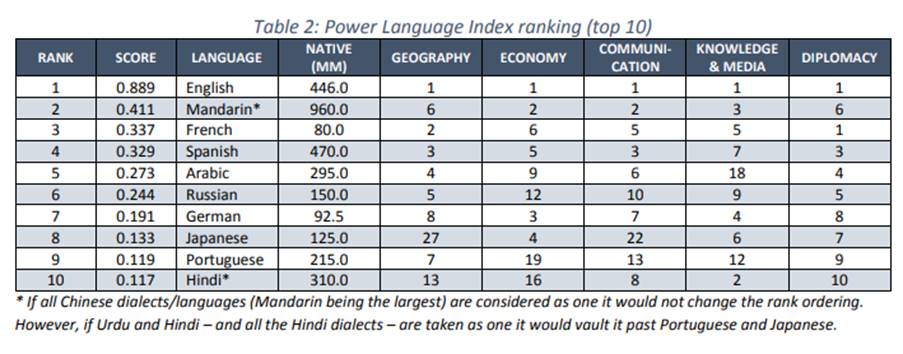
‘Language is an essential component of competitiveness and the results above explain (in part) why London and New York are the world’s two premier cities. Likewise, Hong Kong and Singapore, with their English infrastructure, rather than monolingual Tokyo, are Asia’s financial capitals. Indeed, it is no coincidence that eight of the top-10 global financial centres are English-speaking/proficient cities.’
4. The pragmatic and mathetic functions
From the point of view of ex-colonial countries, the focus
generally falls on the practical or utilitarian value of English, its
role in modernisation, economic and social development and so on, as these
countries endeavour to recover from the stagnation, etc. of the colonial
interlude.
We can also think about English in its mathetic
function: ‘language as reflection’, as ‘a resource for thinking with’, an
instrument for ‘the construction of reality’ (M.A.K. Halliday).
But while originating in particular cultures, such ideas ‘do
have power’, and ‘their power over the minds enables them to spread across
cultural, geographical and ethnic boundaries, influencing people’s views of the
universe and providing more satisfactory ways of construing reality’.
This opens out ‘an unprecedented prospect of world-wide
intellectual participation and parity’. Currently, most third world countries
are concerned with simply the transfer of technology and science from more
developed countries in an effort to reduce economic and material disparities.
5. Hegemony, homogenisation and marginalisation
However, there are critics of the pre-eminent position enjoyed by English today. If we take the view that language and culture cannot be easily divided, then we are left in a situation where Anglo-Saxon predilections are surreptitiously imposed on the world. This is hegemony – the dominance of the English language, and perspectives associated with the users of the English language. Another charge is that of the homogenisation of thought through the language and the marginalisation of traditions of thought and views of reality not associated with this powerful instrument.
Associated with this is the hegemony of the world view that this language and the discourse associated with it help create, that of the dominant groups in the English-serviced global endeavour. Language is not a neutral code, it constructs views of reality associated with characteristic habits of mind, modes of understanding, ways of making meaning, and kinds of knowledge. These habits, modes, etc. have a clear ideological aspect, which cannot be ignored.
Language is a guide to social reality. . . . the ‘real’ world is to a large
extent unconsciously built upon the language habits of the group. No two
languages are ever sufficiently similar to be considered as representing the
same social reality. The world in which different societies live are distinct
worlds, not merely the same world with different labels attached . . . We see
and hear and otherwise experience as we do because the language habits of our
community predispose certain choices of interpretation. (Sapir, Selected
Writings)
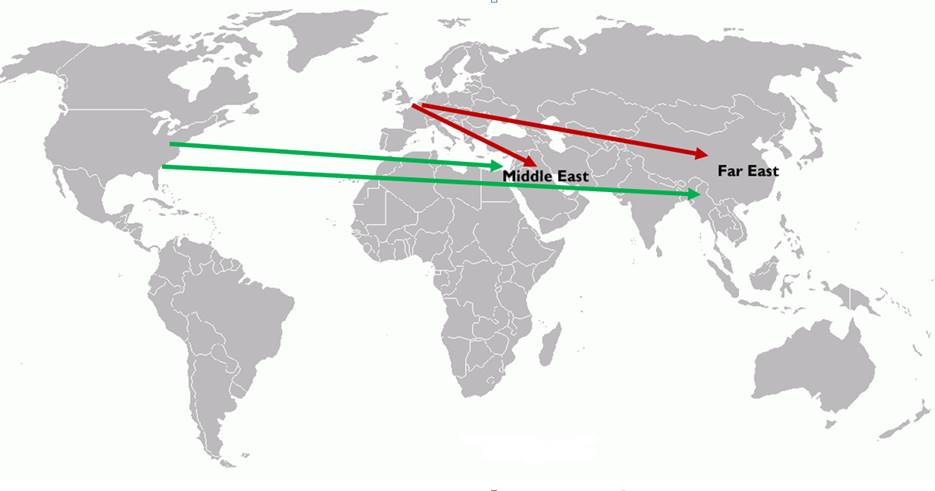
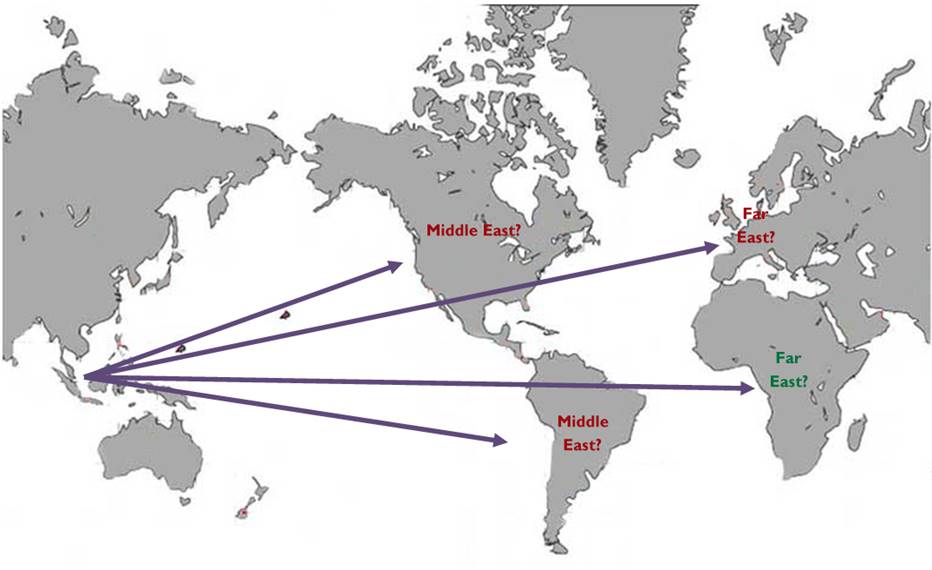
Some terms that are used today reveal a Eurocentric perspective.
- ‘the continent’
- ‘summer vacation’
- ‘autumn/winter
sales’
- ‘the
mystical strains of the Orient’
- ‘the
magic and mystery of darkest
- ‘the mysterious harmonies of ancient civilisations’
The dominance of the English
language also means that the media in the
Another charge that has been made against English is that of a ‘killer’ language (Crystal, Language Death (2000)). There are thousands of ‘endangered’ languages and the inroads made by ‘big’ languages means that the total number of languages on earth spoken fifty years from now will be much reduced.
From the point of view of especially developing, ex-colonial
countries, the situation raises a major paradox. On the one hand, they
desperately need the advantages English brings though its pragmatic and mathetic functions (no place for ‘adolescent nationalism’),
if they are to take their rightful place among the community of nations.
A consensus in the the view of both linguists and creative writers in the language: English can be regarded as a ‘pluricentric’ language, ie, a language with ‘several interacting centres, each providing a national variety with at least some of its own (codified) norms’ (Clyne 1992). But even so, each might not be equal, and there is the possibility of ‘linguistic racism’ (see https://www.bbc.com/worklife/article/20210528-the-pervasive-problem-of-linguistic-racism).
There is another solution suggested by Jennifer Jenkins
(King’s College,
6.
The empire writes back
Language is frequently an issue in postcolonial studies. We see comments such as the following:
So my answer to the question, Can an African ever learn English well enough to use it effectively in creative writing? is certainly yes. If on the other hand, you ask: Can he ever learn to use it like a native speaker? I should say, I hope not. (Chinua Achebe 1965)
This kind of love-hate relationship with the English language is not untypical, and there have been writers who began writing in English but foreswore it later. A well known example is that of Ngugi wa Thiong’o (b. 1938, originally known as James Ngugi), a Kenyan writer of Gikuyu descent, began a very successful career writing in English. However, after his imprisonment in 1978 he turned his back on English and instead wrote in his native Gikuyu. He wrote Decolonising the Mind in 1986 and this constituted his ‘farewell to English’. For him, language is a way people have not only to understand the world, but also to understand themselves. In the context of the African continent, English was a ‘cultural bomb’ which would eventually eradicate memories of pre-colonial cultures and histories and a way of establishing the hegemony of colonial perspectives and cultures. As Ngugi puts it,
[A] specific culture is not transmitted through language
in its universality, but in its particularity as the language of a specific
community with a specific history. Written literature and orature
are the main means by which a particular language transmits the images of the
world contained in the culture it carries.
Language as communication and as culture are then
products of each other. . . . Language carries culture, and culture carries,
particularly through orature and literature, the
entire body of values by which we perceive ourselves and our place in the
world. . . . Language is thus inseparable from ourselves as a community of
human beings with a specific form and character, a specific history, a specific
relationship to the world. (Ngugi 1986: 15-16)
Other writers like Salman Rushdie (in his essay ‘Imaginary Homelands’) however advocate a different approach:
One of the changes [in the location of anglophone writers of Indian descent] has to do with attitudes towards the use of English. Many have referred to the argument about the appropriateness of this language to Indian themes. And I hope all of us share the opinion that we can’t simply use the language the way the British did; that it needs remaking for our own purposes. Those of us who do use English do so in spite of our ambiguity towards it, or perhaps because of that, perhaps because we can find in that linguistic struggle a reflection of other struggles taking place in the real world, struggles between the cultures within ourselves and the influences at work upon our societies. To conquer English may be to complete the process of making ourselves free. (Rushdie 1992: 17)
Talib (The Language of Postcolonial Literatures) adds:
… the original ‘owners’ of English
have ‘loaned’ it – or, indeed, have given it away – to so many other people
that they have in effect ceased to become its unique owners. Moreover,
something very different from the attempt to make English distinct from the
original language can happen. This ‘borrowed tongue’ – if it can continue to be
described as such – is so entrenched in the culture of many of the ‘borrowers’
that they can become more proficient in it than the ‘lenders’. In spite of its designation
as a ‘borrowed tongue’, it may even attain the status of a nation language, if
its general level of proficiency is high, as is the case in
The solution is not to turn your back on the English language but to remould, refashion it to reflect your values. This seems to be like the argument for NEs. These issues are addressed in Bill Ashcroft, Gareth Griffiths and Helen Tiffin’s book The Empire Writes Back (1989). They discuss the process of replacing the standard language with a local variant through abrogation and appropriation, defined as follows.
Abrogation is a refusal of the
categories of the imperial culture, its aesthetic, its illusory standard of
normative or ‘correct’ usage, and its assumption of a traditional and fixed
meaning ‘inscribed’ in the words. (Ashcroft et al. 1989: 38)
Appropriation is the process by which the language is made to ‘bear the burden’
of one’s own cultural experience. . . . Language is adopted as a tool and
utilised to express widely differing cultural experiences. (Ashcroft et al.
1989: 38–39)
When you’re ready to take the quiz based on this topic, go to the IVLE page and click on ‘Assessment’ on the left, and then on ‘Global English’
References
Ashcroft,
Bill, Gareth Griffiths, and Helen Tiffin (1989). The Empire Writes Back.
Ammon,
Ulrich (1991). Die internationale Stellung der deutschen Sprache.
Berger, Peter and Thomas Luckmann (1967), The Social Construction of Reality. Harmondsworth: Penguin.
Boardman,
Mark (2005), The Language of Websites.
Chan, Kai L (2016), Power Language Index. Available online: https://www.kailchan.ca/wp-content/uploads/2016/06/KC_Power-Language-Index_May-2016.pdf
Clyne,
Michael G. (ed.) (1992). Pluricentric languages: Differing norms in different
nations.
Crystal, David (2000) Language Death (Cambridge: Cambridge University Press).
Erling, Elizabeth J. and Alan Walton (2007), ‘English at
work in
Hamel, Rainer Enrique (2007), ‘The dominance of English in the international scientific periodical literature and the future of language use in science’, AILA Review 20, pp. 53–71.
Heah,
Hilgendorf, Suzanne K. (2007), ‘English in
Kress,
Gunther R. and Robert Hodge (1979). Language
as ideology.
Lee, Huan Yik; M Obaidul Hamid; and Ian Hardy (2021), ‘Characterising language policy and planning in international organisations: ASEAN insights’, Current Issues in Language Planning DOI 10.1080/14664208.2021.1965742
McArthur,
Tom (2000), The English Languages. (
Ngugi wa Thiong’o
(1986).. Decolonising the Mind: The
Politics of Language in African Literature.
Rushdie, Salman (1992). Imaginary Homelands Harmondsworth: Penguin (Non-Classics).
Sapir,
Edward (1949), Selected Writings of
Edward Sapir in Language, Culture, and Personality, ed. David G. Mandelbaum
(
Talib,
Ismail (2002), The Language of
Postcolonial Literatures (