Peter
Tan
|
Office: AS5/0604
|
EL2111
|
|
|
Email: PeterTan<at>nus.edu.sg (Replace <at> with the appropriate symbol.) |
Office Hours: by appointment |
Historical Variation
in English |
|
|
Telephone: +65 6516 6038 |
Lecture slot: Monday 10.00–12.00noon |
Lecture Venue: LT9 |
|
|
Tutors: ·
Dr Peter Tan ·
Ms Liu Ya |
|||
A discussion forum as well as self-assessment is available at
Canvas site
This syllabus is located online
at:
http://courses.nus.edu.sg/course/elltankw/history
It will be constantly updated, so
please keep don’t download material too early.
Description
|
|
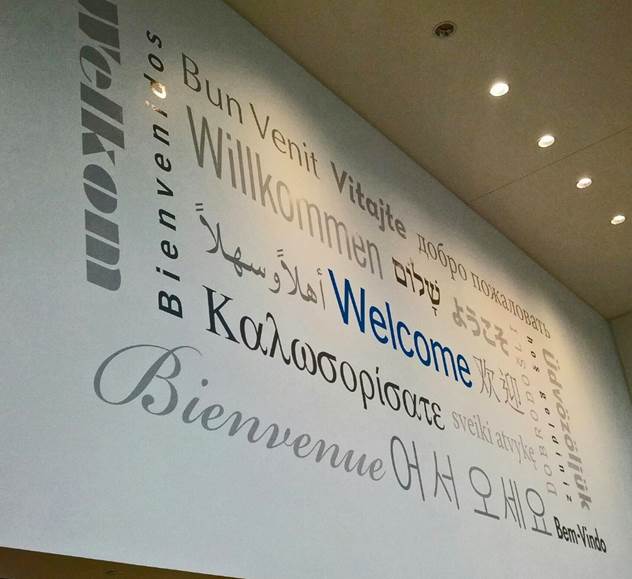
Have you ever wondered why some of
the basic words in various European languages seem so similar (Welcome,
Willkommen, Welkom)? Or why it is that doctors and botanists use so many words
that are derived from Latin? Or why some words associated with the law are
based on French borrowings (‘treason’, ‘judge’, ‘court’)? Or why the French
themselves use English borrowings like ‘le weekend’ or ‘le parking’, like how
Malay speakers might use ‘lesen’ (licence) or ‘tiket’ (ticket)? Why did
Shakespeare and Chaucer use thou and thee and why don’t we today? Why are
there these strange inconsistencies in English, where -ough can be pronounced
so many ways (‘bough’, ‘cough’, ‘tough’, ‘though’, ‘thorough’, ‘through’)? The answers to these and other
questions lie in where English comes from. Before the time of Shakespeare, it
was pretty well confined to the few million speakers in Britain; today it is
the world’s preferred language. Photo: https://www.flickr.com/photos/brainwise/8584322844/ © brainwise (photo cropped and processed) |
Readings
Main
Text
- David
Graddol, Dick Leith, Joan Swann, Martin Rhys and Julia Gillen (eds), Changing English (London: Open
University/Routledge, 2007). Students can also consult the earlier
version of this book: David Graddol, Dick Leith and Joan Swann, English: History, Diversity and Change
(London: Open University/Routledge, 1996)
Other Prescribed Readings
- Barber,
Charles; Joan C. Beal and Philip A. Shaw
(2009), The English Language: A Historical Introduction, 2nd edn.
(Cambridge: Cambridge University Press) [First edn (1993) is OK
too]
- Crystal, David (2003), English as a Global Language, 2nd edn (Cambridge: Cambridge
University Press)
[First edn (1997) is OK too]
Additional Print Resources
- Andersson,
Lars-Gunnar and Peter Trudgill (1990), Bad Language (Penguin: Harmondsworth)
- Crystal, David (1995), The Cambridge Encyclopedia of the
English Language (Cambridge: Cambridge University Press)
- Culpeper, Jonathan (1997), History of English (London:
Routledge)
- Fennell, Barbara A (2001), A History of English: A
Sociolinguistic Approach
(Oxford: Blackwell)
- Gopinathan, S et
al. (eds.) (1998), Language,
Society and Education in Singapore (Singapore: Times Academic)
- Gupta, Anthea
Fraser (1994), The Step-tongue (London:
Multilingual)
- Johnson, Keith (2013), Shakespeare’s
English (London: Pearson)
- McArthur, Tom (ed.) (1992), The Oxford Companion to the
English Language (Oxford: Oxford University Press)
- McIntyre,
Dan (2009), History of English: a resource book for students (London:
Routledge)
- Pyles, Thomas and John
Algeo (1993), The Origins and
Development of the English Language, 4th edn. (Fort Worth: Harcourt
Brace Jovanovich)
- Schneider,
Edgar S. (2011), English around the world: an introduction (Cambridge: Cambridge
University Press)
- Schreier,
Daniel and Marianne Hundt (2013), English
as a contact language (Cambridge: Cambridge University Press)
- Stockwell, Robert and Donka Minkova (2001),
English words: history and structure
(Cambridge: Cambridge University Press)
- Watts,
Richard and Peter Trudgill (2001), Alternative
histories of English (London: Routledge)
If you have a fascination with Old English and want
to try learning it, look up Stephen Pollington (1997), First Steps in Old English (Norfolk: Anglo-Saxon). Or if your
fascination is with Latin, there are some interesting sites: click here
to view them.
Online Material
(Please download
a few days before the lecture in case there are updates. Please see download requirements)
- The
Writing System
- Grammar
- Phonology
- Vocabulary
- Reasons
for change
- Genealogical
classification
- The Old
English period
- The Middle
and Modern English period
- Standardisation
and the development of academic writing
- The
development of American English
- The rise
of the non-Anglo Englishes
- Global
English
Other Resources
 A five-part television series
entitled The Adventure of English
by Melvyn Bragg is available on youtube.
A five-part television series
entitled The Adventure of English
by Melvyn Bragg is available on youtube. - Oxford English Dictionary, online
(for NUS networked computers or if you use NUS dial-up; click on ‘Enter OED
Online’)
- Online dictionary site, dictionary.com (which takes entries
from, among others, the American Heritage Dictionary and the Webster’s
Dictionary)
- Online
English Grammar
- Internet English Grammar
- Essay
Writing Guide for English Language (includes information about citation)
- Lecturer-student
contract
- NUS Library Catalogue (LINC)
·
The History of English website
by Luke Mastin
Assessment
The
final mark achieved in this module is based on the Continuous Assessment (60%)
and a Take-Home Exam (40%). The breakdown is in the table. (Click on the items
for further details.)
|
Class Test (27-ii-2023) |
20 marks |
|
Essay (due Tues, 21-iii-2023) |
20 marks |
|
Group Project (27.iii–7-iv-2023) |
10 marks |
|
10 marks |
|
|
Final Exam (3-v-2023, 1–3pm) |
40 marks |
EL2111 Time-table (links
will be included when they are ready)
Schedule
|
Week |
Date |
Topic |
Tutorials |
||
|
1 |
Monday, |
Introduction and
focus. |
nil |
||
|
2 |
Monday, |
The grammatical system and change. (Read Graddol 2007, pp. 56–59, skim through Ch. 6) |
nil |
||
|
3 |
Monday, |
No lecture: holiday for Chinese New Year |
No tutorial: CNY |
||
|
4 |
Monday, |
The sound system and change. (Skim through Graddol 2007, Ch. 5) |
|||
|
5 |
Monday, |
Vocabulary and change. (Read Jackson & Amvela, Ch. 2) |
|||
|
6 |
Monday, |
Reasons for change. (Read Graddol 2007, pp. 61–64; 179–188; 229–232) |
|||
|
– |
Mid-term break (18-ii-2023–26-ii-2023) |
||||
|
7 |
Monday, |
Class test. Indo-European: the beginnings of English. (Read Barber, The English Language, Ch. 3) |
|||
|
8 |
Monday, |
Video: ‘The Mother Tongue’. |
|||
|
9 |
Monday, |
Middle English and Early Modern English. (Read Graddol 2007 pp. 64–73) |
|||
|
10 |
Monday, |
Standardisation and the development of academic writing. (Go
through Graddol 2007,
Ch. 3) Essay due Tuesday, 21-iii-2023. Topic skipped: |
|||
|
11 |
Monday, |
The rise of the non-Anglo Englishes (Read Crystal, English as a Global Language, Ch. 2; skim through Graddol 2007, Ch. 1; pp. 222–223; 149–152) |
|||
|
12 |
Monday, |
Global English. (Read Crystal, English as a Global Language, Ch. 4) |
|||
|
13 |
Monday, |
Overview, revision and discussion of the examination* |
|||
|
|
Revision week (19–23-iv-2023) |
||||
|
Exam week 1 |
|||||
|
Exam week 2 |
Exam: 3-v-2023, 1–3pm |
||||
*The lecture on 10th April will be for one hour. The second
hour will be the make-up for the tutorial group affected by Well-being holiday
(Thursday, 6th April).
|
Some of the notes are in PDF format. You need the Adobe
Reader to view these files. If you haven’t got it, please download it by
clicking on the icon on the right. |
|
|
Sometimes I will use the IPA (International Phonetic
Alphabet). The font that I use is Times New Roman Phonetic. If you
haven’t got the font in your system, you will encounter problems in
displaying the characters. You can download this font by clicking on the icon
on the right. |
|

